Every physical product in your supply chain carries some form of identification. For most brands today, that means a barcode or a QR code, cheap, fast to print, universally readable, and good enough for most of what the last decade required. But “good enough for the last decade” is not the same as fit for what is coming. The EU Digital Product Passport is not a labelling update. It is an infrastructure requirement, and it is forcing brands to ask a question many have been deferring: is a QR code a real digital identity, or just a shortcut to one?
QR Codes: Accessible, Affordable and Structurally Limited
There is a reason QR codes became the default consumer-facing product identifier. They are free to generate, printable on any existing packaging line, readable by every smartphone on the planet without an app, and effective at linking a physical product to digital content. For basic use cases, a landing page, a product description, a recycling guide, they work well.
The problems emerge when you ask more of them. A QR code is a printed mark. It has no memory, no processor, no ability to distinguish itself from a copy. Anyone who can photograph a QR code can replicate it onto a counterfeit product, onto a fraudulent certificate, onto a grey market label that points to the same verification page as the original. The code itself cannot tell you whether the product it is printed on is genuine. It cannot tell you whether the seal has been broken. It cannot update itself to reflect what has happened to the product since it left the factory.
This matters enormously for the Digital Product Passport. The DPP is not just a data record, it is a claim about a specific physical object. It says: this product was made from these materials, in this facility, to these standards, and this is what has happened to it since. A QR code as the identifier for that claim creates a structural problem: the code is detachable from the product, replicable by anyone, and provides no technical guarantee that the product carrying it is the product the DPP describes. You end up with a passport that can be photocopied and attached to anything.
A serialised QR code, unique per unit, server-validated on every scan, closes some of these gaps. Duplication detection means a cloned code could be flagged. That is meaningfully better than a static code. But the code is still physically on the surface of the product, still visible, and still limited to whatever the printing and validation infrastructure supports at the moment of scan. It is a better version of the same fundamentally passive technology.
RFID: A Different Category of Technology
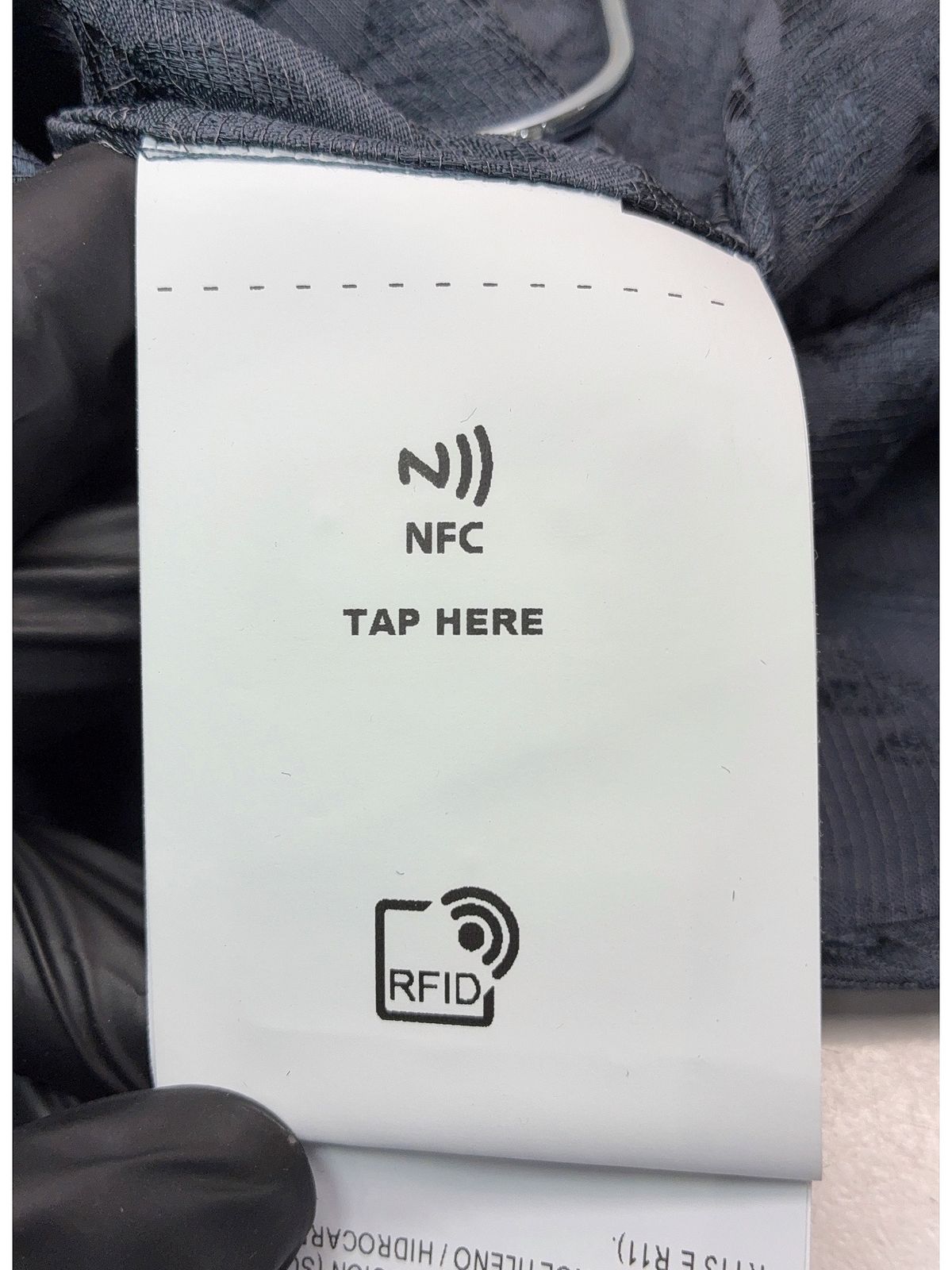
RFID, whether NFC or Dual-Frequence RAIN RFID & NFC ,is not a better QR code. It is a different kind of thing entirely, one whose properties make it structurally suited to what digital product identity actually requires, rather than what was convenient to print on existing packaging.
An RFID chip is active electronics, not a printed mark. It communicates wirelessly, stores data in onboard memory that can be read and written across the supply chain, and in its secure implementations performs cryptographic operations that tie its identity to a specific physical object in ways that cannot be replicated by copying a surface marking. It does not need line-of-sight. It does not degrade with handling, moisture, or abrasion. And it does not need to be visible on the product surface to do its job, it can be fully-embedded and invisible.
For supply chain applications, this translates into operational capabilities that printed codes cannot match. A pallet of tagged products passing through a warehouse gate can be scanned entirely, every item accounted for, every identity confirmed, without anyone touching a single box. This is how Decathlon achieves near-99% inventory accuracy across its global store network: not by scanning smarter, but by tagging every product and letting the readers do the work as products move. The intelligence is in the infrastructure, not in the effort of the operator.
Enabling Secure and Dynamic Digital Product Passports
What the Digital Product Passport requires, at its most fundamental level, is a persistent, updatable, trustworthy identity for each individual product unit, not for the SKU, not for the batch, but for the specific item. Every stage of the product’s lifecycle, manufacture, distribution, sale, repair, resale, end of life adds a new entry to that identity record. The identity needs to be readable by different actors at different points, updatable by authorised partners, and protected against tampering or fraud.
RFID memory architecture is designed for exactly this. The tag can carry a layered data structure: some fields readable by anyone, some readable only by authorised supply chain partners, some updatable only by specific actors at specific lifecycle stages. A brand can write manufacturing data at the factory, a logistics partner can update distribution records at the warehouse, a retailer can log point-of-sale data, and a repair centre can add service history all to the same tag,which can then be compared to the one in the database. In essence, the tag is signed, adding security and traceability.
This is what “digital twin” means in practice: not a cloud record that refers to a product, but an identity that travels with the product, accumulates history as it moves, and can be verified at any point in the chain by any authorised reader. This constitutes an Advanced Digital Product Passport promise of lifecycle transparency provenance, environmental impact, repair history, end-of-life routing is technically achievable with this model in a way that a QR code pointing to a cloud record is not.
For regulatory compliance, this also provides future-proofing that matters commercially. The DPP requirements are expanding, new product categories, richer data fields, stricter verification standards, extended producer responsibility obligations. A brand that has deployed RFID-based digital identity infrastructure does not need to rebuild when the regulation evolves. The tag can carry new data fields. The reader infrastructure already exists. The compliance investment is made once against an infrastructure that adapts, rather than repeatedly against labelling that needs to be replaced.
Built for the Product
The physical relationship between an identifier and the product it identifies turns out to matter more than it sounds. A QR code is applied to the surface of a product; it is, in a meaningful sense, separate from the product and can be separated from it. A label can be peeled, a package can be reused, a code can be photographed and reprinted. The identifier and the product are related by convention, not by physics.
RFID tags can be integrated directly into the product itself woven into a garment, moulded into a sole, embedded in a closure, cast into a component. When this is done, removing the identifier requires destroying the product. The physical-digital link is not a matter of convention but of construction. The identity cannot be detached because the tag is part of the object.
This has obvious implications for authentication, it is the basis of tamper-proof NFC, where the tag carrier is engineered to register a permanent, cryptographically logged tamper event the first time the product is opened. But it also has implications for the broader DPP use case: a lifecycle record is only as trustworthy as the link between the record and the physical product it describes. When that link is an embedded chip rather than a surface label, the trustworthiness of the entire record improves.
Dual-Frequency RFID: One Technology Across the Entire Value Chain
One of the most practically significant developments in RFID for brand protection and engagement is the maturing of dual-frequency technology chips that operate at both UHF (860–960 MHz, the supply chain and retail standard for long-range bulk reading) and HF/NFC (13.56 MHz, the standard native to every modern smartphone used for access control). These are not two technologies co-existing in one package as a compromise. It is a single identity infrastructure that covers both the supply chain and the consumer interaction layer without any translation or data reconciliation required.
At the UHF layer: a pallet passes through a warehouse gate at 10 metres and every item is read simultaneously. A container clears customs and the entire manifest is scanned without unloading. A retailer counts stock in the stockroom with a handheld reader in seconds rather than hours. These are the operational efficiency gains that have driven RFID adoption in logistics and retail for two decades.
At the NFC layer: a consumer taps the same product with their smartphone and receives a verification result, a provenance story, a warranty activation prompt, or a personalised engagement experience, all from the same tag, the same identity record, the same backend. No duplication of data. No reconciliation between supply chain and consumer systems. The identity the warehouse read at receiving is the same identity the consumer taps at home, and every interaction along the way is a record in the same product’s history.
This convergence matters because the DPP requires both layers. Compliance-oriented supply chain tracking and consumer-facing transparency are not separate requirements satisfied by separate systems. They are two access points to the same underlying product identity and dual-frequency RFID is currently the only single-technology solution that serves both without architectural compromise.
Beyond Compliance: The Multi-Purpose Value of RFID
The risk with any discussion framed around regulatory compliance is that it makes RFID sound like a cost of meeting a requirement. That framing misses most of the commercial case. The infrastructure deployed for DPP compliance is the same infrastructure that enables tamper detection, product registration, after-sales services, warranty management, resale authentication, circular economy tracking, and consumer engagement not in the future, but as immediate capabilities of the same deployed tag.
A consumer who taps a product to verify its authenticity is also, with one interaction, registering ownership, activating a warranty, connecting to after-sales support, and entering a direct brand relationship that no retailer or distributor intermediates. That relationship, the direct consumer connection created by a tap at the moment of product interaction is something brands in indirectly distributed categories have been unable to create at scale since distribution became complex. RFID makes it structural rather than aspirational.
Tamper detection is part of the same story. When RFID is integrated into the product in a way that registers physical interference, the tamper-proof NFC approach used for premium bottles, closures, and sealed products, the tag becomes a product integrity sensor as well as an identifier. A consumer, a customs inspector, or a retailer can tap a product and learn not just whether it is genuine but whether it has been opened, refilled, or interfered with. That is a capability that no QR code, hologram, or visual security feature can match.
The Consumer Experience Comparison
It is worth being concrete about what the difference between QR and RFID actually feels like to the person holding the product.
A QR code experience requires the consumer to locate the code on the packaging, open their camera, hold it steady at the right distance and angle, wait for the code to resolve, and follow a link. The content they receive is often generic, the same page any consumer sees, and provides no verification that the specific product they are holding is what it claims to be. It is a marketing channel dressed as authentication.
An NFC tap experience requires the consumer to hold their phone near the product (hence, next to the tag), any part of the phone, within a few centimetres, for about a second. The experience that follows can be personalised to their ownership record, their product’s specific history, their location, and their language. The verification result confirms not just that the product type is authentic but that this specific unit has a verified identity and a tracked history. The interaction is faster than unlocking a phone, requires no deliberate scanning behaviour, and generates a richer, more trusted result.
The difference in consumer perception maps onto the difference in underlying technology: QR codes feel like a feature added to a product; NFC taps feel like the product itself communicating. For brands investing in connected product experiences, that distinction matters enormously to the quality of the relationship being built.
Conclusion: From Identifier to Digital Identity Platform
QR codes will remain part of the digital product identity landscape for years. They are cheap, universal, and adequate for a significant proportion of consumer interaction use cases. The question is not whether to use them at all, it is whether to treat them as the foundation of a product identity strategy, or as one access point within a broader infrastructure.
The EU Digital Product Passport changes that calculation materially. A regulation that requires persistent, updatable, verifiable product-level identity across the entire lifecycle covering manufacture, distribution, use, repair, and end of life is a regulation that describes RFID-based product identity far more accurately than it describes a printed code. Brands that read the DPP as a labelling requirement and respond with QR codes will meet the minimum compliance bar at minimum cost. Brands that read it as the regulatory articulation of an infrastructure investment they should be making anyway in digital product identity that doubles as brand protection, consumer engagement, after-sales intelligence, and circular economy infrastructure will find that RFID is not a compliance cost at all. It is the foundation for everything they want their products to do.